Heating elements: cartridge, band or tubular?
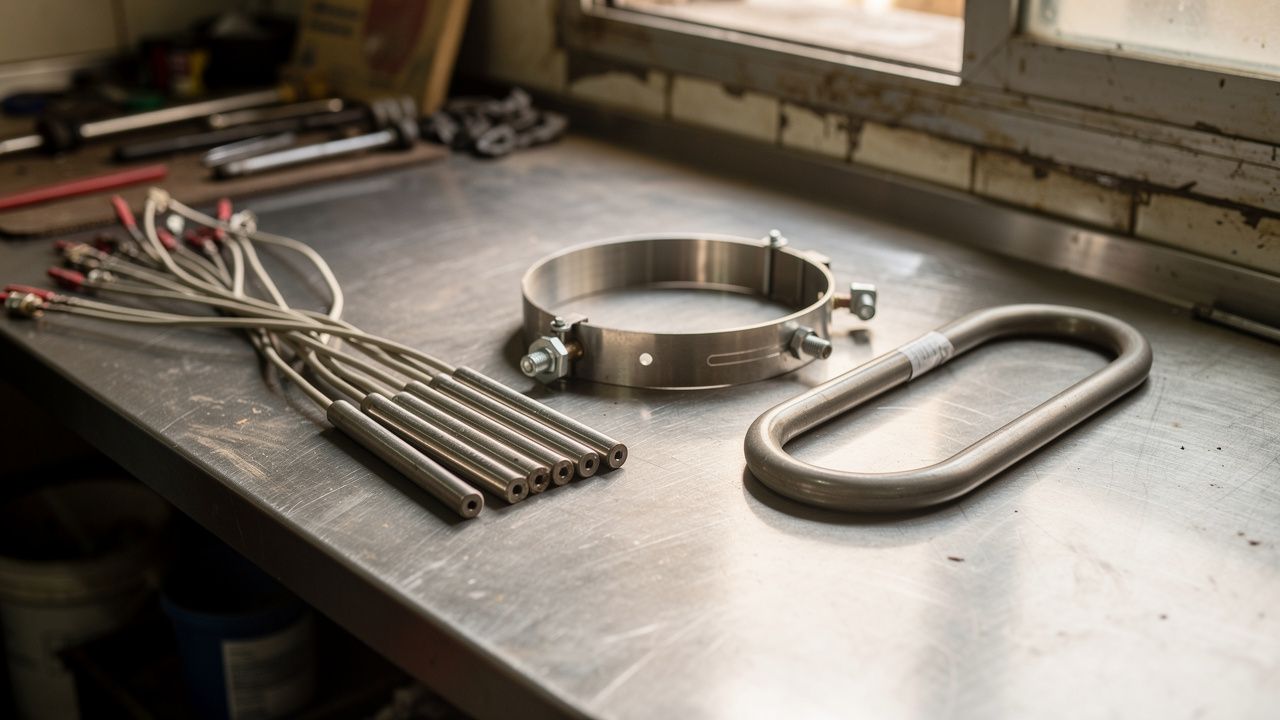
Heating elements turn electricity into heat. The shape depends on what you are heating.
Cartridge heaters
A thin metal rod that goes into a drilled hole: moulds, hot plates, packaging and sealing machines. Measure the diameter and length exactly. The hole must be a close fit: an air gap traps the heat and the element burns out early.
Band heaters
A metal ring that clamps around a barrel or a nozzle, as on injection moulding and extrusion machines. Measure the inside diameter and the width, and check where the clamp and the wire leads go, and if you need a hole for a thermocouple.
Tubular heaters
A metal tube, straight, U-shaped or bent to shape, for heating water, oil or air. For water, copper or stainless steel; for oil, ask for a lower watt density (less power for each cm of length), so the oil does not burn on the surface.
Voltage matters more than you think
Power changes with the square of the voltage. A 400 V element on 230 V gives only about a third of its power. A 230 V element on 400 V gives about three times its power and burns out in minutes. Always give the seller both the watts and the volts.
Also ask about the wire lead length and type, and if a built-in thermocouple is possible. With the old element in your hand, most sellers can make an exact copy.