Wire and cable: which size for your load?
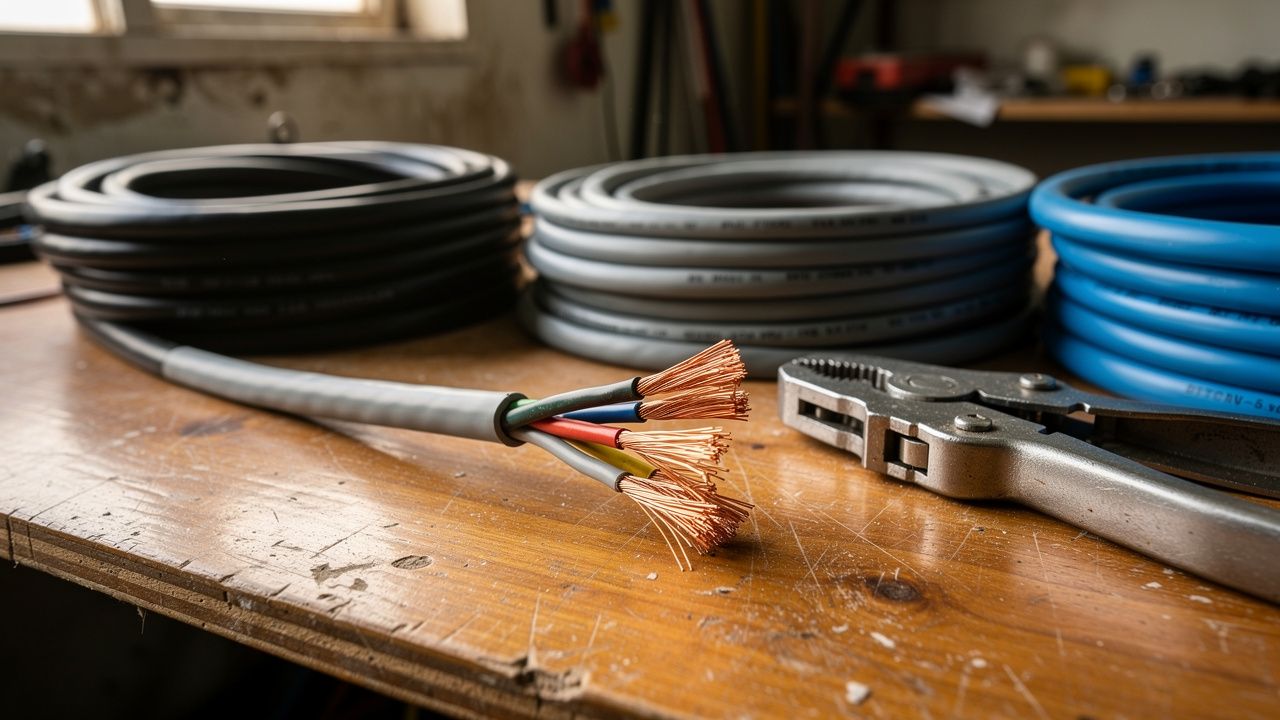
A wire that is too thin gets hot. Over months the insulation hardens and cracks, and that is how many electrical fires start. Choosing the size is the first job.
A rough guide (copper, short runs inside a building)
- 1.5 mm²: lighting, on a 10 A breaker.
- 2.5 mm²: sockets, on a 16 A breaker.
- 4 mm²: up to about 25 A.
- 6 mm²: up to about 32 A.
The breaker protects the cable, so the cable must always be able to carry the breaker’s current. Long runs (more than about 30 m), cables in hot places and many cables bundled together need a bigger size. For anything beyond a simple circuit, ask an electrician to calculate it.
Copper or aluminium
Aluminium is cheaper and lighter, but carries less current: you need a bigger size, and special lugs at the ends. For building wiring and machines, copper is the usual choice.
Solid or flexible
Solid (one thick strand) is for fixed wiring inside walls. Flexible (many fine strands) is for machines, panels and anything that moves or vibrates.
Undersized cable is a real problem
Some cables sold as 2.5 mm² have less copper than that. Buy known brands from known sellers, and compare the weight of a coil with another brand’s. Check the voltage rating too: 450/750 V for building wire, 0.6/1 kV for power cables.
What to tell the seller: size, number of cores (for example 3×2.5 or 5×6), copper or aluminium, solid or flexible, and the length.