Which circuit breaker do you need?
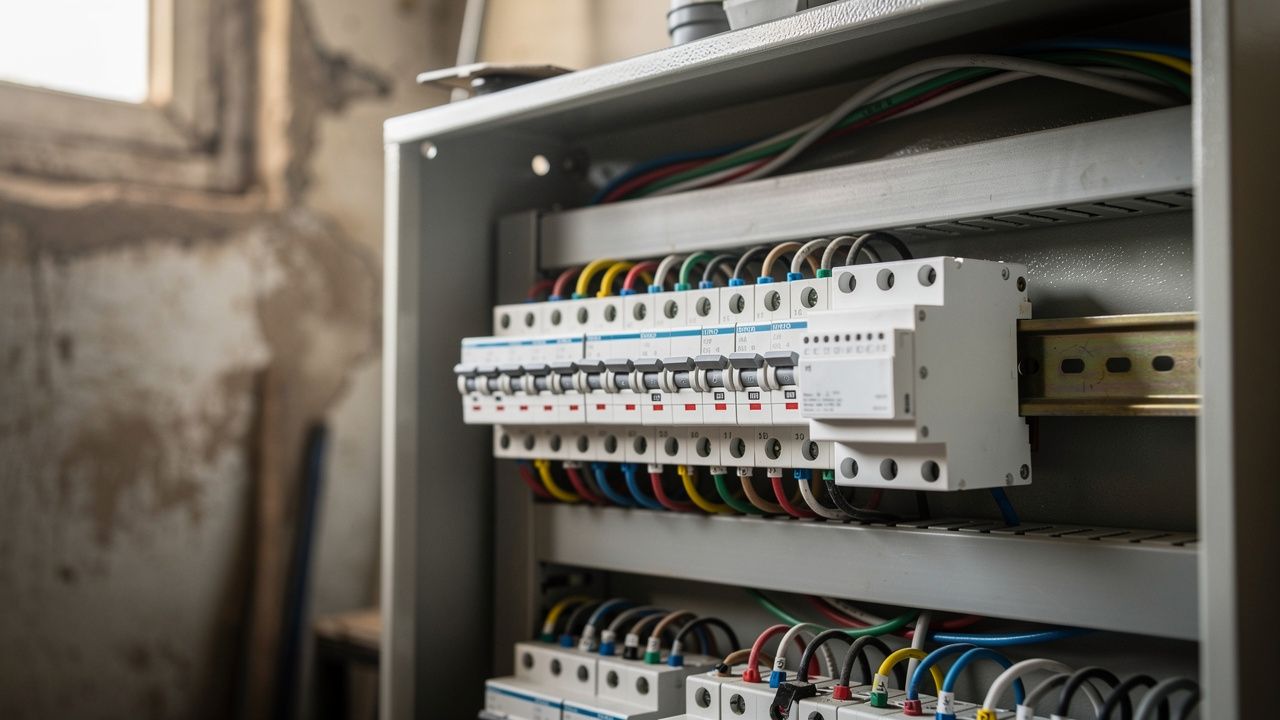
A breaker cuts the power when too much current flows, before the cable overheats. Four questions pick the right one.
1. Which kind
- Miniature breaker (MCB): the small DIN-rail breakers, up to about 63 A. For lighting, sockets and small machines.
- Moulded case breaker (MCCB): a bigger box for main panels and big loads, from about 16 A to over 1,000 A, often with adjustable settings.
- Motor protection breaker: set to the motor’s nameplate current, it protects the motor against overload and a lost phase.
2. The current
The breaker’s current must be no higher than what the cable can carry. The breaker protects the cable, not the device.
3. The curve: B, C or D
Starting current is high for a moment, so breakers are made to wait a little:
- B: trips at 3–5 times the rated current. Heaters and long cables.
- C: 5–10 times. The usual choice: lighting, sockets, small motors.
- D: 10–20 times. Transformers and motors with heavy starts.
4. Breaking capacity (kA)
The biggest short-circuit current the breaker can safely cut. 6 kA is common in buildings; near a big transformer or in a factory, 10 kA or more. Your electrician can tell you what your panel needs.
And for people: an RCD
A normal breaker protects cables. To protect people from an electric shock, add a residual current device (RCD) of 30 mA for sockets, bathrooms and outdoor lines.
Tell the seller: the kind, current, curve, number of poles (1P, 1P+N, 3P, 4P) and kA.